Achievement Unlocked: Revision Milestones

Looking back, the big turning point in my writing career came when I embraced revision.

Cocky teenage me thought everything I wrote was awesome, and only needed light editing to be perfect. Eventually, I realized that the first draft is only a starting point, and the most important part of the writing process is elevating your book from promising to kick-butt drop-dead awesome through an Edge of Tomorrow-like process of revising it again and again until you have honed it to a bleeding edge of badassery.

It can be really hard, though, to know when you’re ready. When you’ve leveled up your skills in the unforgiving lava dungeon of revision until you are prepared to fight the boss monster of querying.

It occurred to me today that there are certain milestones writers tend to pass as they gain XP crunching their way through writing career side quests. I spent a few minutes brainstorming a list of some revision achievements many writers seem to unlock before finding success in publishing. If you’re wondering if you’re high enough level to poke your head into the boss monster dungeon, it might be worth taking an look to see how many of these you can check off.

You certainly don’t need to have done all of this stuff—if you’re good enough to get it right the first time and haven’t had to do some or even most of these things, that’s awesome. But I’d suggest that if you can’t check off at least 5-6 of these, you may want to grind some more revision levels before querying. And I would suspect most agented writers can probably score at least 50%.

Have you ever (on any book, not necessarily your current one):

Cut a major character, or merged them with another character?

Cut an entire chapter?

Significantly changed the order of events (moving whole scenes/chapters around)?

Cut an entire subplot?

Added an entire subplot and woven it into the story?

Started over completely?

Rewritten an entire chapter (or the equivalent) from scratch?

Had 50% or fewer of your first draft words make it to the final draft?

Done a complete reimagining of a major character?

Rewritten your first page(s) completely 5+ times?

Done a revision pass focused specifically on improving one general/abstract aspect of the book, such as voice, setting, stakes, through line, etc?

Changed POV, tense, viewpoint character(s), age category, genre, or another similar major meta-structural element?

Written 5 or more drafts of a novel?

Completed more than one novel?

Trunked a novel?

What am I forgetting? If you comment with other common “achievements,” I’ll add ‘em to the list! (And maybe I’ll do a more reach/advanced achievement list someday and make it into a full-fledged Revision Hell test or something.)

Happy revising!
Breaking a Scene List into Arcs

In a previous post, I talked about color coding my scene list by stakes. That’s only one of the ways I use my scene list, which is really a super handy all purpose tool to look at a book’s structure in all sorts of ways. (To review, it’s just a list of all scenes in order, with a short phrase naming each scene.)

Another way I’ve used it that came in really handy on my current revision is to use the scene list to break the book up into arcs or acts.

I look at the scene list and try to identify turning points in the book, and map out arcs connecting those turning points. You can look at varying sizes of arcs, from a few major acts to lots of shorter arcs—whatever’s useful to you—and even nest them if you want to get fancy. For my current round of revisions on THE TETHERED MAGE, I wound up identifying 10 arcs of varying sizes.

After I identify these turning points, I break up my working copy of my scene list accordingly, and I try to name or label each section based on its overall arc. If I can’t identify an overall direction, or I want to label a section “A Bunch of Random Stuff Happens,” it probably means I have a bunch of disconnected scenes without a clear through line. (This happened to me on this latest pass, and it was super useful to catch it so I could find/make a through line.)

Here are a few of the redacted-for-spoilers labels for my current working arcs in THE TETHERED MAGE, for example:

  • Meet [REDACTED], Your New Problem
  • [REDACTED] Is Getting Worse And Maybe It’s [REDACTED]’s Fault? LOOK ALL THESE THINGS ARE CONNECTED!
  • Starting to Figure Stuff Out & Have Victories & Solve Stuff…
  • OH WAIT NO EVERYTHING GOES TO HELL

(Those aren’t consecutive, except for the last two.)

For other projects and past drafts, I’ve sometimes used more specifically descriptive phrases, as opposed to the more abstract and structural ones above. Here’s a made-up example of this approach:

  • Part One: Searching for the Golden Potato
  • Part Two: Potato Found, but Stolen by Void Bunnies!
  • Part Three: Hunting Down the Void Bunnies
  • Part Four: NOPE! Running From the Void Bunnies
  • Part Five: All Seems Lost (Void Bunny Ambush & Aftermath)
  • Part Six: Unlocking the Inner Potato (It Was Within You All Along)
  • Part Seven: Stealing Back the Golden Potato
  • Part Eight: Void Bunnies Destroy Seattle
  • Part Nine: Unleashing the Golden Potato
  • Part Ten: Post-Potato-splosion Wrapup (soup w/leeks & bacon, mmm)

It’s kind of like the scene list zoomed farther out.

In addition to helping spot structural issues, I also find breaking up the scene list into sections to be really helpful for tackling my edits in bite-sized chunks. For instance, if one of the 25 things I want to work on in this revision is strengthening character X’s voice, and character X doesn’t appear until my 3rd arc, I don’t even have to worry about that item on my list until I get to that section.

It helps me manage the revision a piece at a time, without having to juggle too many things in my tiny brain. And I can identify what I most want to focus on in each arc, and keep that focus in mind as I revise that section.

I’m sure there are a ton of other ways you could use this, too — and other writers probably have their own variations on this technique. I like making lists, because that’s how my brain works. Some people may prefer to map out acts more visually, or go crazy with sticky notes, or make an Excel spreadsheet, or name their cats after various plot themes and throw out some catnip mice and see what happens.

Some people may even be so awesome they can keep track of all this stuff in their head and not need 32 pages of notes to do a revision. (HA HA WHAT KIND OF LOSER HAS A 32 PAGE REVISION PLAN ANYWAY? NOT ME.) (*Switches tabs while you’re not looking*)

For me, though, the scene list is the X-Ray that lets me look at my story’s skeleton. And this is one way to make sure everything’s all connected properly, and not just a loose pile of bones.

Going on Submission (Now With Scorpions)

The first rule of Sub Club is you do not talk about Sub Club. So there’s not as much out there about the process as there is about querying. While I was on sub, I know the posts other writers who’d gone through the process made about it were a lifeline for me, so I vowed I’d write my own once I was safely through that dark valley.

Here is that post. I’m not sure how actually helpful it is, per se, but I hope you enjoy it.

Congratulations! Your novel is going on submission! Are you excited? Are you SUPER EXCITED? Are you bouncing up and down because this could be it, and your novel could FINALLY be published?

You fool. You sweet summer child.

No, actually, really, you SHOULD be excited. Because this COULD be it! And you should be proud. You’ve made it so far, and you have a really awesome book. You’ve done a ton of work, your agent loves it, and you’re finally ready to BE THROWN INTO THE ARENA BLINDFOLDED WITH ONLY A TOOTHBRUSH TO DEFEND YOU FROM A DOZEN GIANT SCORPIONS—

Whoops, wait, no, it’s fine. It’s totally fine. It’s not like that at all.

Mostly, it’s not like that because you don’t even get to be in the arena. You’re sitting outside, nervously munching popcorn, with no idea AT ALL how your book baby is doing in there with that toothbrush fighting those scorpions.

(Also, I should say here that editors are not at all like scorpions, and actually are very nice people who love books and don’t want to crush your soul at all. It’s probably more accurate to imagine that arena is full of frolicking kittens. But that’s not nearly as dramatic, so we’re going with scorpions for now, and also, the point is you’re stuck outside the arena eating popcorn, so YOU DON’T EVEN KNOW. They could be unicorns. The arena could be empty. IT’S A MYSTERY.)

And here’s the thing. You sit there with your popcorn, and you wait.

And wait.

The silence drives you crazy within hours, but unless you’re very lucky, you have to wait for months. And there is nothing you can do to make it go faster.

DO NOT TRY TO UNDERSTAND THE SILENCE. You will want it to mean something. You want its horrific eternity of torment to have some hidden signal or significance. Maybe you’re not hearing anything because the editors loved it and are getting more reads…Or maybe because they’re totally unenthused and put it at the bottom of their pile… Or because your agent doesn’t want to hurt your feelings… Or because THE GIANT SCORPIONS ATE YOUR AGENT OH NO WHAT IF SHE NEEDS RESCUING…

Stop. No. Put down the popcorn. Walk away from the arena. Do not listen to the Silence. Do not look at the Silence. Do not let the Silence look into you.

What you SHOULD be doing, everyone will tell you, is writing the next book. That way if your book is getting really tired fighting those scorpions, you’ll have fresh, maybe better-equipped reinforcements ready to throw in there.

But if you can’t manage that, go find something else to obsess about. Something that will consume your life. Buy a house, or have a really pressing work deadline, or get a puppy, or something. You want to be so distracted running around putting out fires (Hey! Maybe literally! You could become a firefighter! They get awesome hats!) that you forget you’re on sub, even for one brief, fleeting, precious moment now and then.

(Probably writing the next book is best. Do not use this blog post as an excuse to get a new puppy even though your spouse/mom/landlord says you can’t.) (Actually, puppies are awesome, so I’m not judging.)

Here is the secret. Here is the one and only thing the Silence means. Are you ready? Can you handle the deepest and most profound mystery of authordom?

Here it is:

PUBLISHING

IS

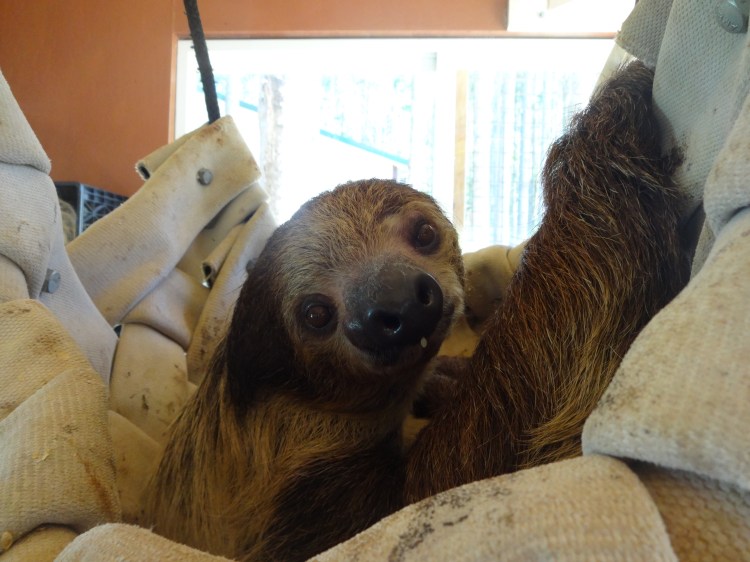
SSSSSSSSSSLLLLLLLLLLLLLOOOOOOOOOOOOOOOOWWWWWWWW.

sleepy-sloth

That’s all. There is no deeper significance. It’s just slow.

Eventually, your agent will come by with a nice lemonade slushie and more popcorn and the halftime score. The score may be something simple, like SCORPIONS: 4, YOUR BOOK: 0. Or it may be more complex, with feedback or agonizing IT WAS SO CLOSE details like making it to acquisitions before facing the poisonous tail-barbs of defeat.

Suffice to say you’ll almost certainly get rejections first, and that’s totally NORMAL AND FINE. IT’S FINE. EVERYTHING IS FINE. Do you know why?

Because only one thing can end your journey toward publication. And that’s you giving up.

If not this book, the next book. If not that one, the one after that. YOU ARE AN UNSTOPPABLE FORCE. You’ve made it this far; you have to be.

Someday your agent will come back from the arena with a huge smile and good news about your book’s stunning victory. You will enter the arena at last, toothbrush held victoriously aloft. You will fight side by side with the scorpions (or kittens, or unicorns, or whatever they turn out to be), carrying your  book on to its next battle: publication. It will be AWESOME. Bring snacks.

I’m cheering you on in the stands.

The Best Birthday Present Ever

So I have to share my call story with you guys, because it was strange and wonderful and funny and involved bees. HUNDREDS OF ANGRY BEES. I am not making this up.

It all started on my birthday.

My awesome agent Naomi Davis called me, which basically gave me a heart attack right there, because usually we communicate by email so I knew SOMETHING was up. The conversation went a bit like this:

Naomi: So I just got a call from an editor who really likes your book and—

Me: (Flails) DID YOU KNOW IT’S MY BIRTHDAY?!

There was no offer yet; the editor had called to ask some questions like would I be okay with making the book Adult instead of YA (YES FINE IT WAS ON THE LINE ANYWAY TOTALLY COOL) and making it longer (SURE YES ABSOLUTELY I CAN DO THAT) and maybe a series (!!!!!!!!!!!!! HOLY CRAP HELL YEAH!!!!!!!!!!!!!!!).

And so Naomi and I were cautiously squeeing on the phone together, because clearly SOMETHING was going on, here. I was like OMG BEST BIRTHDAY PRESENT EVER (Okay, except maybe my first puppy, she was pretty amazing) and basically running around the house bumping into walls with excitement.

And then the waiting.

I kept my phone so close to me it’s a wonder I didn’t absorb it into my body through osmosis. We went out for my birthday dinner to my favorite local restaurant, and I just kept my phone there in line of sight because I MUST NOT MISS ANY CALLS. My brother called to wish me a happy birthday, and it was all I could do to not greet him with “You’re not my agent!”

The next morning, I wanted desperately to check in with Naomi, but I knew she’d have called me if there was any news. So I did what anyone would do: I came up with a completely fabricated excuse to send her an email asking about some minor detail of our phone call, and included a line about OMG THE WAITING IS KILLING ME EEEEEEEEEEEEE.

Naomi sent me back a short email containing the following fateful lines:

“Actually, I heard from the editor today. Are you around this evening for a followup phone call? I have to do a little bit of beekeeping this afternoon otherwise I’d call sooner.”

WHAT

WAIT WHAT SHE HEARD FROM THE EDITOR BUT BEES?!?!?!?!?!

WHAT DOES IT MEEEEEEAAAAAAAAAAAAAAN?!?!?!??!?!?!??!?!

Cue complete panic.

Here’s an actual exchange I had with my husband:

untitled

bees-screenshot-2

When I finally talked to my agent that night, she explained that she couldn’t call me earlier because she was splitting a hive, a process that apparently involves being surrounded by thousands of angry bees and sounds both delicate and badass.

But more to the point, she told me I had been offered an amazing book deal for a trilogy with Orbit, which is such an amazing publisher I just want to draw little hearts around their name every time I type it. (Can you imagine the little hearts for me? Good!)

I’m pretty sure there was swearing and squealing and a lot of incoherent noises. My kids were listening, and they knew this was the Big Call I’d been waiting for, and they were asking me if my book was going to be published, but I was listening to Naomi tell me the details, so I scrawled out the word TRILOGY on a scrap of paper and handed it to them. They thought it was hilarious watching me bounce up and down babbling like a loon about how happy I was for the rest of the night (and, oh, for the next several weeks).

And thus ends the story of the angry bees, the Best Birthday Present, and my dream come true.

May all your life’s fairy tales have as happy an ending!

Big Announcement!

Sooooooo… I have some news.

I have AWESOME news.

I have the VERY BEST NEWS IN THE WORLD!!!!!!!!!

I am giddy with delight to announce (and I cannot believe I’m saying this and it’s true and this is really happening) that Orbit has acquired my fantasy novel, THE TETHERED MAGE, for publication in Fall 2017!

NO SERIOUSLY THIS IS A REAL THING THAT IS HAPPENING! HOLY CRAP!!!!!!!!

(I am being totally professional about this, as you can see.)

And you know what else? You know what? IT’S GOING TO BE A TRILOGY! So I really hope you like my book, because there’s going to be THREE OF IT! WHEEEEEEEEEEEEE!!!!

LOOK! Here’s proof I’m not dreaming:

deal-announcement-tethered-mage

You guys, I can’t even tell you how happy I am. This has been my dream since I was literally five years old. And Orbit is an amazing publisher, and my editor (Lindsey Hall) is amazing, and my agent (the incredible Naomi Davis) is a goddess.

I am so far over the moon I can’t even SEE the moon from here. I’m past the Oort cloud in deep space. It’s crazy. I probably need some oxygen and I might die. OF JOY.

YAAAAYYYYYY!!!!!!!!!!!!!!!!!!!!!!!!

Stakes Map

I did a new structure thing today which worked really well for me, so I wanted to share it with all my fellow writers!

I was side-eyeing my current revision, which involves adding a bunch of new scenes, and thinking there might be some patches where I had too many sitting-around-and-talking scenes in a row. I needed a way to zoom waaaaaay out and look at the story structure to check for places where I let the tension drop for too long.

Here’s what I did:

First, I had already made a scene list. I find this is super handy for looking at big structural things. It’s just a list of every scene in the book, in order, with short names (usually just a handful of words) for each scene. Here’s a made up example:

Greg misses bus, starts walking
Ninja attack
Running away, rescued by Sophie
Sophie reveals Greg is chosen one

Etc. You get the idea.

The new thing I did was to color code each scene in the list by the stakes. I might use a different color code for a different type of book, but for this one I did red for high-stakes action scenes, blue for high-stakes non-action scenes (the character has a lot to lose), and green for low-stakes talky scenes (the character doesn’t have much at risk, though plot points still happen).

This was awesome, because it made any places where I had a bunch of low-stakes talky scenes in a row really jump out at me. See what I mean in this example:

Greg misses bus, starts walking
Ninja attack
Running away, rescued by Sophie
Sophie reveals Greg is chosen one
Sophie fills Greg in over donuts
Greg in school crushing on Stanley
Greg fails math test
Greg moping over lunch
Greg goes home, gets in trouble w/mom for missing bus
Greg catches bus fine next day
Greg has to do makeup work in math class
Ninjas kidnap Stanley

The middle has way too much green. I can see immediately that it’s a problem. Then I can experiment with different solutions in my scene list until I have a better balance of colors.

For instance, in this example story I might cut a bunch of scenes and insert a higher-stakes one to avoid dropping the dramatic tension on the floor while Greg messes around:

Greg misses bus, starts walking
Ninja attack
Running away, rescued by Sophie
Sophie reveals Greg is chosen one
Greg in school crushing on Stanley
Greg tries to ask Stanley out
Ninjas kidnap Stanley
Sophie fills Greg in while they track down ninjas to get Stanley back

That might be too little green. Readers do need time to take a breath, dig in, and get to know the characters when they’re not in the middle of a huge crisis. But this color code technique will let me spot those problems, too, and identify spots where I need to give the reader a bit of down time or breathing space between epic fight scenes and shocking revelations.

When I tried this with my current draft, it let me get a bird’s eye view on stakes and pacing, move stuff around to fix problems, and make changes to up the stakes where needed. It not only made it easier to correct the issue I’d already identified, but it helped me spot another potentially slow stretch I needed to fix.

I’m totally doing a stakes map like this for every book from now on.

Time

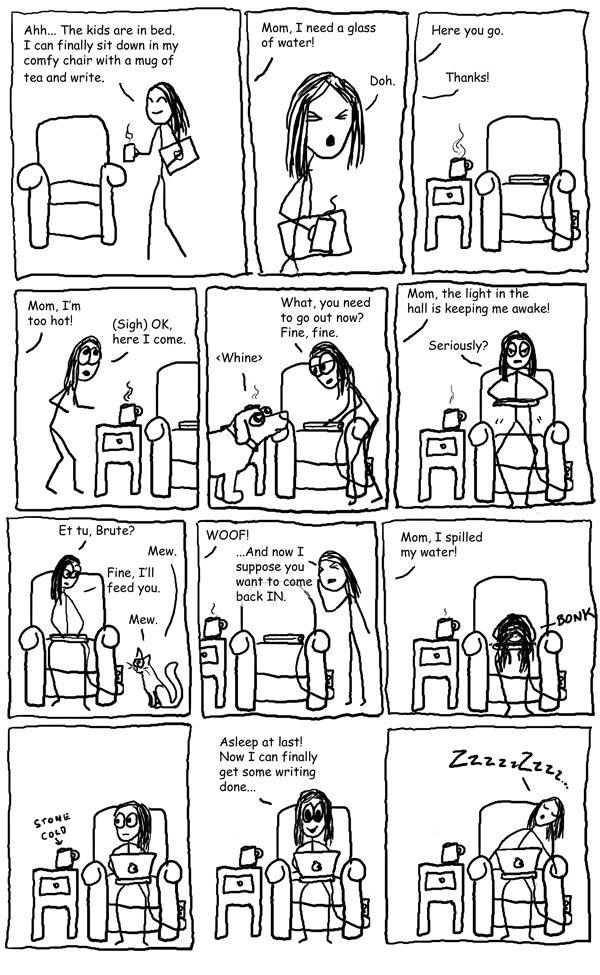
This spring has been busy for me, with my day job needing more hours than it used to and various family and homeowner things consuming my life. It made me think of this comic I did a while back. I suspect most writer parents can identify.

Trying-to-Work

Lies Writers Tell Ourselves: My Beta Reader Doesn’t Get It

So you send off your draft to some awesome, kind beta readers, and they send you feedback. Most of it is great, but there are one or two comments that are way off base and show they really missed the boat.

Maybe they’re suggesting a character do something that character would never do. Or urging you to take the book in a direction that’s not at all where you want to go. Maybe their feedback shows a total lack of understanding about the genre. It might even make you wonder if they really read the book.

Pancake

It can be tempting to ignore feedback like that completely. But the fact is, even if they are completely wrong about your book, they still had a reader reaction that prompted them to give you that feedback. Instead of throwing out their ridiculous comment, take a good, hard look at your book.

Why did they have that reaction?

What’s the real problem behind that reaction?

Forget their suggested solution. How would you fix it?

If they’re suggesting out of character actions for a character, maybe that character isn’t developed enough, or needs to be cut, or needs a stronger arc or voice. If they’re urging you to take the book in a direction you don’t want to go, maybe the book needs more conflict, or higher stakes, or a more unique hook. If they show a lack of understanding of the genre, maybe your book could be more accessible to casual readers. If it seems like they didn’t read the book…Well, if they were skimming, they weren’t drawn in. You have work to do.

I know it’s easy for me to read a suggestion and instinctively have a resistant reaction. I want to defend my book. I worked hard on that thing!

But I didn’t send it to my beta readers for validation. (I mean, sure, part of me wants validation. But that’s not the part of me that should be driving when I’m getting ready to revise.) I sent it to them to find out how I could make my book better.

Sometimes, they’re wrong, and the problem is actually something else entirely. But there usually is a problem.

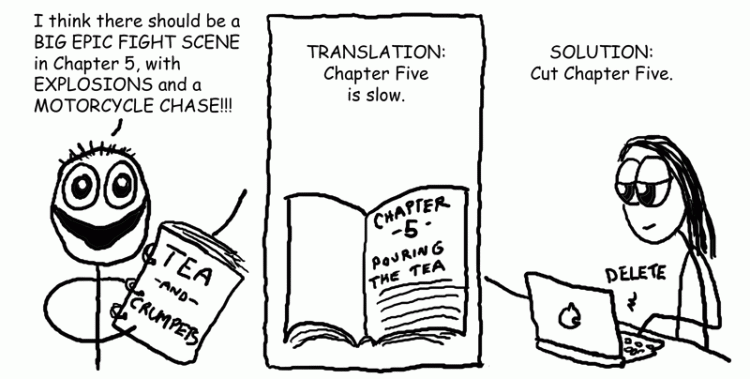
Translation

Other times, they’re right, and I just don’t want them to be right, because the revisions would be a lot of work. In which case, TOO BAD FOR ME. Back to work it is!

These days, I happen to be blessed with awesome beta readers, and the feedback they give me is generally spot on. I am super lucky that way. So sometimes instead of asking “What’s the actual problem?” I instead wind up asking “But should I do even more than they’re suggesting?”

A wise friend of mine recently observed to me that taking constructive criticism is as much a skill as giving it. She was so, so right—and it’s a skill all writers need to learn.

Lies Writers Tell Ourselves: Publishable Quality

Long ago, when I was young and innocent and just starting out on my journey through the world of publishing, I had the idea that my job was to write a book good enough to be published. Once I did that, everything else would follow—because if it’s good enough to be published, that means it’ll be published, right?

HA HA HA HA HA. Oh, what a fool I was.

I think this is a common myth, though. More than once, I had various industry professionals tell me my book was publishable quality, too, reinforcing my idea that there was this bar, and once you passed it, you were in. But this is a very dangerous illusion.

It’s a strange idea in the first place. Books get published all the time which you or I might very well not consider of Publishable Quality. And I’ve certainly beta read a decent number of books which I consider to well surpass that bar which have not yet found a home with a publisher. It’s not like you can put a manuscript on the Awesomeness Scale and see if it rates at 90% or above and slap a “Grade A” sticker on it and put it on the shelf.

One problem with the Publishable Quality idea is that it obscures the truth: publishing is incredibly subjective. If you and I did a blind taste test of 20 novels and had to check off which we thought were of Publishable Quality, we’d be extremely unlikely to come up with perfectly matching lists at the end. Nearly every published debut novel out there got rejected at some point. The idea that there’s some way to objectively gauge novel quality leaves us open to greater pain with rejection, because then instead of meaning we didn’t find our book’s  agent/editor soul mate, it means our book wasn’t good enough.

The Publishable Quality myth comes with another hidden catch. Even if you assume we could come up with some vague level of “Yeah, most people agree this is good enough to be a published book,” there are more books meeting that bar than there are slots for books to traditionally publish. Writing a good book is a rare skill, and one we should be proud of—but it’s not so rare that there isn’t still competition once you clear the elusive “publishable” bar.

Which leads to perhaps the most insidious danger of this notion of Publishable Quality. It can lead you to believe that once your book hits that level, you can stop trying to make it better. I know when I first started querying, I thought I just had to make my book good enough. But now that I’ve immersed myself in the world of writing and publishing for a while, I know that’s not true.

You can’t stop at good enough. You probably shouldn’t even stop at as good as I can make it. You have to keep going until as good as it can possibly be.

If you strive for less than that, you might still get published. It’s a subjective business, after all. But you’ll have failed to do your book the justice it deserves. You’ll have missed opportunities to make yourself a better writer.

So don’t ask yourself “Is this book publishable?” Ask yourself “How can I make this book even better?” You’ll go less crazy and write a better book.

Go Back and Revise, or Keep Drafting?

I’m at that point on my WIP where I know I’m going to make some edits to chapters I’ve already written that will significantly change a viewpoint character. I have to make the choice whether to go back and revise now, or to forge ahead and finish the first draft before revising.

Normally, I’m a big fan of revising first when this sort of thing happens. It’s hard to build on what came before if you don’t even know what that is. If I haven’t rewritten those scenes, their emotional content can’t inform what I’m writing now. I can’t make subtle references back to what happened there, or let the particulars of those key events drive how my characters act and make decisions now. I can’t refer back to those unwritten scenes in dialogue or internal monologue.

In this case, though, I’m going to forge ahead. Because this is a multi POV project and I’m trying to do some cool things with how the POVs play off each other, I already know there’s a lot of revising in my future. Anything I go back and revise now is just going to get revised again when I’m done, and the new stuff I write now is probably also going to get revised…maybe even completely rewritten. This is not going to be a “clean, awesome first draft” kind of book. It’s going to be messy before it gets pretty.

So I’m going to let go of perfectionism (for now) (at least a bit) and forge ahead, choosing momentum over continuity in this draft. Different books require different strategies!

I know I’m not the only one who’s faced this dilemma… I’d love to hear how others have handled it!