Why Query Contests are Awesome

I didn’t get my agent from a query contest, but I entered a bunch of them back when I was querying, and I found contests to be incredibly helpful to me as a writer. But not for the reasons I thought they would be.

Some people do find their agents through contests, but I know I got far more requests querying. When you query, you can pick agents you’re interested in, and who are seeking what you write. It’s a better way to find the perfect match.

Contests are, however, AMAZING for several things:

Feedback – Some contests offer feedback to entrants. These are incredible opportunities! But even contests that don’t offer feedback often will abound with chances for query exchanges or critique giveaways on the contest hashtag.

Community – Contests are often a great way to meet other writers through the social media surrounding the contest. You can learn from tips other writers post, meet potential CPs or beta readers, and simply know you’re not alone in the trenches.

Field Testing – If your query gets picked for a contest, that’s a great sign that it’ll get requests from agents, too. If it doesn’t get picked for one contest, that doesn’t necessarily mean anything—they’re often very competitive—but if you enter a few and don’t get picked, your query or your book may need more work before you send it out to agents. Entering contests is a great, risk-free way to field test your query without closing any doors.

Case Studies in Awesomeness – You can learn a lot by checking out the winning queries in major contests, even if you don’t enter yourself. It can be especially interesting when there are multiple rounds with revisions between rounds, so you can see how the query improves, or if mentors post public feedback you can learn from. You can read the queries (and excerpts, where applicable) and see which ones really want to make you read the book, and learn from what those writers do.

I entered a bunch of query contests when I was querying the novel that got me my agent (the one I wrote before THE TETHERED MAGE). The feedback I got from contests, and from people I met through contests, was absolutely invaluable in improving both my query and my entire novel; I wouldn’t have gotten my wonderful agent without what I learned from them.

I actually entered an early draft of the novel that would become THE TETHERED MAGE in PitchWars when I was still revising it, figuring it would be a good way to test my query at least… and wound up getting requests from all four of the mentors to whom I applied. I had to frantically finish my revisions and send off the full, and wound up getting picked as a mentee… and then got an offer from my lovely agent just a few days later and had to withdraw! But I knew from the huge difference between the judge reactions to that proto-TTM novel and the reactions to my previous novel that I’d finally gotten this right, and this was THE BOOK.

So if you’re a writer looking for an agent, I highly recommend checking out contests. Even if you don’t wind up participating, you can learn a ton and meet great people just by stalking them. (Er, stalking the contests, that is, not the people.) You don’t have to win contests to get published, but they are a fantastic place to find community, learn, and practice, so you’ll be much more prepared to revise your novel into its fully evolved badass form, write a killer query, and get the agent of your dreams.
Success Over 40 and Other Mythical Creatures

So, there was some talk recently about whether you’re washed up as a writer after a certain age and do you have to get published in your twenties and when should you give up and blah blah blah. I think a lot of people have said what needs to be said—which comes down to IT’S NOT OVER TIL IT’S OVER, BABY—but I also get that there are people out there who are despairing of ever finding the end of the publishing rainbow as the clock ticks on, so I wanted to share a bit of my personal story in case that might encourage anyone.

First of all, I am *GASP* over 40.

Okay, not a lot over 40. But turning 40 is a thing that happened in my past. (NOW YOU MAY LOOK AT MY PICTURE AND GO “WOW, MELISSA, I NEVER WOULD HAVE GUESSED.” WHY, THANK YOU. MOVING ON.)

Second of all, I have literally wanted to be a published writer since kindergarten. I know this because I remember we did an activity in kindergarten where we folded a piece of paper into like 6-8 squares and had to draw pictures of different things we might like to be when we grow up in each square. I put “Writer” in the first square and “Artist” in the second square, and then on reflection added “Princess” in the third square. And then I looked at the other squares like, dude, what more do you want from me? WHAT MORE IS THERE?!

I am sure my parents were thrilled to see I had selected such practical career choices. (In fact, I remember one of them—I’m not sure which—explaining to me that you couldn’t become a princess as a job, and that you had to be born the daughter of a king, and I remember thinking that was TOTAL BULLSHIT.)

I wrote picture books as a kid. I made my first real stab at a novel when I was maybe seven or eight, and got about 30 typewritten pages into it, which isn’t bad for a seven-year-old. It was about a princess who was a powerful mage AND had a magic sword AND rode a unicorn AND a dragon (though not at the same time, that would be weird), because WHO SAYS YOU CAN’T HAVE IT ALL?

In fourth grade, I wanted to publish a book of poems, and my dad got me Writer’s Market. I read that thing cover to cover (what was WRONG with me?) and submitted some stuff and was Terribly Serious about it all.

In my late teens/early twenties, I wrote a really (REALLY) bad novel about a teenage boy who was secretly a prince AND a dragon AND a mage AND a really good swordfighter, because WHO SAYS YOU CAN’T HAVE IT ALL? …So, yeah, that didn’t get me an agent. Thank goodness. But I tried. An agent even called me up and basically ranted at me on the phone about how I was wasting my potential. She ended the call by saying she had no doubt I’d be published someday. (Needless to say, she didn’t offer rep.)

It was very weird. In retrospect, I’m honored, and she was right on all counts.

I had to calm down and stop writing Mary Sue characters. I had to improve my craft, develop humility and empathy, and embrace revision. I had to grow up, both as a writer and as a human being. (Now, some people are already quite grown up as writers and human beings in their twenties. YAY! I salute those people. They’re amazing. That was not me.)

I got an agent when I was ready, as a writer. I got a publishing contract when I was ready. Before that, I still had more work to do. And that’s fine. I did the work. I learned the things. I wrote and wrote and wrote, I kept learning and getting better, and I didn’t give up.

And now, yay! I have a book coming out in October! MY LIFELONG DREAM IS FINALLY COMING TRUE!

It literally took, what, 35+ years?

And that’s fine. All that time, I was leveling up. Every shelved book earned me a ton of XP. Every word I wrote was a step toward this goal. Some people level up faster than me, and that’s great. But I made it! And you can, too.

The only way to be sure you never get there is to step off the path. Get back on that unicorn—or dragon—or BOTH AT THE SAME TIME, WHY NOT—and ride.

In Which I Squee About My Cover

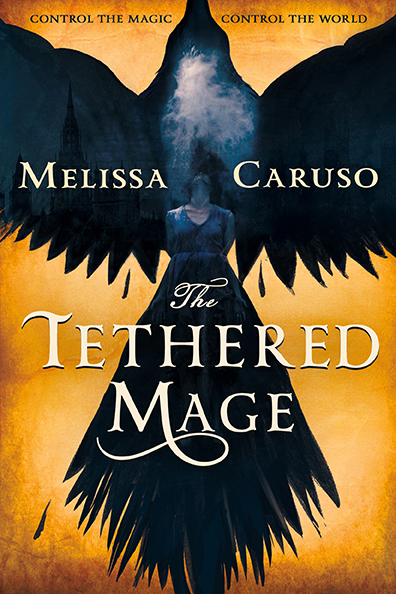
Have you seen the beautiful cover for THE TETHERED MAGE?!

Caruso_Tethered-Mage_HC

(Design: Lisa Marie Pompilio; Art: Crystal Ben & Arcangel)

I love this cover so, so much, guys. One of the many reasons I was super excited when Orbit offered to publish my book is that their covers are FREAKING AMAZING. And wow, they did not disappoint all the little writer dreams of awesome book covers I’ve been having since I was a tiny little girl.

I love the colors. I love the way the bird silhouette grabs your attention right away, but you can keep seeing more details as you look closer (the city in the wings!). I love the swoopy line thing on the M. (See that technical term I used there?)

I look at this cover anytime I start losing steam as I work on Book 2, and then I’m like HELL YEAH! and rev up my writing pace again.

Anyone who knows me well will also not be surprised to hear how ridiculously happy I am to have a raptor on the cover of my book. Let’s just say it’s no accident I called my magical military unit the Falcons… I’ve been a bit of a bird geek since I was in third grade. (I’m a really low level bird geek, though… That particular XP tree goes up REALLY HIGH. I only have my skill bought up to, like, the point where I’m the person my friends ask what the cool bird they saw was. And then I nod sagely and say “Probably a red-tailed hawk,” which is an accurate statement for, like, I don’t know, 80% of the raptors you see over highways in Massachusetts—bear in mind I just MADE THAT NUMBER UP AND IT’S NOT REAL. Not to indulge in a huge parenthetical digression about birds when I’m supposed to be talking about my cover or anything, but suffice to say I THINK I JUST MADE MY POINT about how I like birds.)

Also, I was really amused to realize my cover reveal came on the Ides of March. As I said on Twitter, it’s kinda appropriate… Let’s just say there maaaayyyyy be a certain amount of political intrigue, betrayal, and murder in this book. (That’s really not a spoiler. Like, if you look at the nutrition label for this book, it says “CONTAINS INTRIGUE, BETRAYAL, AND MURDER,” right there.)

I can’t wait to see this cover ON MY BOOK! EEEEEEEEEEEEEEEEEEEEE!!!!!!!!!!!!!!!!

Permission to DNF

I like to finish things.

I’m the type of person who vastly prefers to complete one task before moving on to the next; otherwise, the unfinished thing lurks in the back of my mind, raising its hand periodically to go “Hey, still not finished, over here.” And I’m like “ARGH I know! I’ll get to you soon! Sorry!” Unfinished tasks piling up causes me more anxiety than anything else.

I hate putting aside a book I’m reading without finishing it. Not only is it another thing my brain never crosses off its list, but I feel like I’m abandoning a friend. Leaving the hero hanging off the cliff as he calls after me: “Um, okay, I’ll just wait here a while, I guess.” Meanwhile, I walk away with an apologetic wave, going “Too busy, sorry, maybe later.”

But I’m realizing now that I need to change how I look at not finishing books. I’ve got two kids, a day job, writing, a household to manage, deadlines… and, if I can manage it, maybe even things like eating, sleeping, and a social life! (HA HA HA but no, seriously, that would be nice.) I can’t read three books a week like when I was a teen. There will never be more than 24 hours in a day, no matter how much I wish I had a time turner.

If I want to ever make it through my TBR pile—if I want to be able to walk into the bookstore and come home with a couple books without feeling guilty about the others I haven’t read yet—I need to let go of the idea that I start books to finish them. I need to abandon the Clean Plate Club idea of reading, and approach it with more of a buffet mentality: I’m going to try all kinds of stuff that looks good, but stop after just a nibble with a lot of it to give myself room to get a second helping of those really amazing potatoes (with me, it’s always the potatoes).

The last two books I finished were UPROOTED by Naomi Novik and THE FIFTH SEASON by N. K. Jemisin, and HOLY CRAP, those were both AMAZING. So, so, SO good. Not finishing them was never an option. I HAD to. Part of my brain is still living in each of those books. They were everything I wanted and more than I could have imagined.

I’m a bit late to the party with both, and the reason for that is I didn’t want to let go of the idea I was going to finish Marie Rutoski’s THE WINNER’S CURSE (which I in turn was late to the party for because I didn’t want to DNF something else, and so on, and so on). And the only reason I made it to the party at all was because I finally convinced myself it was okay to put aside TWC when I was maybe 2/3 through, because while I genuinely liked it and was enjoying it, I didn’t feel that compelling drive to finish it. And that meant I kept prioritizing the 500 other things on my Must Do list above reading.

Well, no more. Now I’m going to give myself permission to start novels and not finish them. I’d rather read the first 5 chapters of 10 books than dutifully finish just one book I’m only kinda into.

That way I get to support more authors (by buying more books), learn more as a writer (by at least sampling more books), and have a greater chance of finding those precious books which are so good they don’t give me the option to set them aside, and leave me yearning for more when they’re done. Like really good roasted potatoes, or cheese fondue. (Mmmm, fondue.)

I feel liberated already! Better run out and buy more books to celebrate.

Outlining Process

I fall firmly into the “plotter” category, preferring to plan things in advance when I write a book. I generally have dozens of pages of notes and an outline before I start writing page one.

I wasn’t always that way—in high school, I wrote a (really terrible) novel (on notepads, in pen) with the rule I absolutely couldn’t plan anything in advance, so whatever I was writing would be a surprise to me as I was writing it. That was fun, but the result was… I’m going with unsalvageable. Some people may be cool enough to write a coherent story without an outline, but if I try, it apparently winds up like a bad shonen manga, with way too many fight scenes and no plot advancement. (Or maybe that was just teen me, but I’m not taking any chances.)

Everyone’s writing process is different, of course, and you should go with what works for you. But here are some things I do when developing an outline:

Early Brainstorming Phase – First I roll ideas around in my head for a while, without writing things down. This way I don’t feel locked in to anything during the very early stages when the idea is fragile and new.

Notes Phase – I start writing down all my brainstormy ideas (for plot elements, characters, scenes, you name it) in one doc, in any order, with any level of detail. I’ll get new, conflicting ideas and write those down, too. It’s messy and repetitive and can easily sprawl out to 20-40 pages of notes.

Shaping Phase – This is when I start trying to pull all my brain splooge together into a coherent, well-shaped story. A lot of it feels like putting a puzzle together… If you could make new pieces or redraw the pieces you have to make it work. I can vaguely see and feel the shape the book is trying to form, and I’m muddling my way along to refine and improve that shape. Things I do during this phase often include (but are not limited to):

  • Put scene ideas in a working chronological order. Probably switch this order around a bunch of times trying to figure out what’s best.
  • Summarize all my plot arcs to make sure they follow a line that is compelling and makes sense.
  • Summarize (briefly) all my major characters’ arcs, to make sure they have one, and that they make important choices, have agency, change, etc.
  • Break outline into acts and look at the arc for each act.
  • Look for places to weave stuff together and combine scenes/plotlines/characters/etc: any structural element is stronger if it’s fulfilling multiple functions
  • Describe and define the overall arc for the book. Make sure what I’ve got is fitting into and supporting that arc.

The process varies each time. Here’s a post I made on one process I used for a multi-POV outline that worked pretty well for me.

Revising Phase – When I start to have a rough, first-pass outline, I take a critical look at it. It’s probably a mess, and certainly needs revision. I might:

  • Ask these outline questions (woo more previous posts!)
  • Look for weak points: dribbling along the status quo, “and then some stuff happens/time passes,” stretches where the MC isn’t driving the action, places where the stakes are low or unclear, fuzzy character motivations (would she really do that?), stuff that’s extraneous or repetitive, etc.
  • Do a word count estimate and check whether each section or act of the book takes up roughly the percentage of the book I want it to. Also check whether I have enough material to make the book the right length, or if I need to add more subplots or pare things down.

In my latest outline, I tried something new—looking for good chapter break places before writing the chapters—and it was really helpful. I may make a separate post about that later.

Writing Phase – Eventually I realize I am spending waaaaaay too much time twiddling with my outline and need to get actually writing the book. Ideally, I realize this early on, before I lock down my outline in too much detail, because it really is important for me to leave the outline flexible. It’s going to change when I start actually writing the book—it always does.

Characters might decide to do different things than my outline dictates. I might go to write a scene and feel like no, this isn’t where the story is heading anymore. Or I might get to a scene and go ugh, I don’t want to write this, which is always the sign of a problem. Or I might get new ideas that are more awesome than the old ideas. Anything could happen.So I update and edit my outline as I go, but it’s a different process at that point.

Originally, the outline is an exploration—it’s a tool for finding the path of the story.

Once I start writing, changes I make to the outline are more likely to be mapping known territory: updating the outline to match the unfolding story in my head.

Site Update

I added a new page to this website: News and Links, where I’ll collect external links to articles and stuff pertinent to my books.

Right now it has links to the Barnes and Noble list of 96 SFF books to look forward to in 2017 and the new Orbit Books video introducing its 2017 debut authors, including this dorky lady in a red shirt who somehow snuck into my basement and recorded herself talking about my book. (And the zombie apocalypse. PRIORITIES.)

It was really neat for me to watch the video and get to meet my fellow Orbit debut authors, several of whom I’ve run into on Twitter but not in real life. Plus, their books all sound AMAZING. My poor TBR pile…

After the Offer: Five Things No One Told Me

Getting an offer from such an amazing publisher as Orbit remains a highlight of my life to date, and working with them has been pure bliss. My pre-publication experience has continued to be a dream come true. But there are some aspects of the life of a debut author I couldn’t have guessed at. So here you go… now you can’t say nobody warned you!

1. DEADLINES CHANGE EVERYTHING. My old writing process involved a lot of letting things sit and simmer for a while. Yeah… Let’s just say the slow-cooker method is no longer on the table. Conversely, I keep thinking “Okay, I’d better stop goofing around on this book and do some work—WAIT! This IS work!” Being able to prioritize writing guilt-free is pretty awesome.

2. YOUR BOOK BECOMES BIGGER THAN YOU. Every now and then my lovely editor will casually mention “the team” working on or talking about my book. Every time, I’m filled with a sense of wonder that this is a thing, and there are these people I’ve never met who are helping make my book a published reality. And then I think OH SHIT I CAN’T LET THEM DOWN. (It’s kind of terrifying, actually.)

3. THERE IS SO MUCH WORK. So. Much. Work. This is fine, because I like writing, and I even like revising these days, and I don’t mind hard work. But wow. Don’t get it in your head that once you get a publishing contract, your work is done. It is ONLY BEGINNING.

4. YOU FINALLY UNDERSTAND WHY PUBLISHING IS SLOW. There are so many steps, big and small, between “I WROTE A BOOK WOOOOO!” and final published product. It’s been about seven months since I got my offer, and I feel like the pace has been lightning fast. My editor has always gotten back to me with blinding speed, and I’ve been working my butt off. There has been no fat to cut. The machine is well-oiled. It just has a lot of work to do.

5. IT NEVER STOPS BEING AMAZING. At least, not so far. I still regularly find myself going HOLY CRAP, THEY’RE REALLY GOING TO PUBLISH MY BOOK! And I bounce around the house grinning like a loon. It still feels like a wonderful dream.

2017 Writing Goals

2017 is here! I like to set goals at the start of each year (rather than resolutions), to get my priorities in order. Here are my writing-related goals for the new year:

  • Rock my debut year. THE TETHERED MAGE comes out this Fall! It’s going to be a crazy, wonderful year, full of new experiences I can only guess at. I plan to both work hard and enjoy every minute.
  • Write book two! I’ve been revising forever, and I am SO EXCITED to start a shiny new first draft soon.
  • Read some great adult fantasy. I was focusing on reading YA while I was writing YA, and I have some delectable catching up to do on recent grownup fantasy. (Recommendations welcome!)

Those are the big three I want to focus on. Subordinate goals include:

  • Save time for fun. I want to reserve time for hanging out with my friends and taking my kids on fun outings, and I need to schedule accordingly in advance. If I try to play it by ear, two careers means I’ll wind up working ALL THE TIME. If I pre-book my fun, I can’t weasel out of it to do work instead.
  • Challenge myself. I always like to pick a new area or two of craft to particularly try to level up when I start a new writing project. Gotta figure out what to work on next!
  • Give back to the writing community. I want to support fellow authors, and help up and coming writers seeking agents.
  • That’s probably enough! 2017 is going to be a really busy year, so I shouldn’t get too ambitious. Can’t wait to see what it has in store!

My 2016 Writing Life In Review, One Email Quote at a Time

2016 may have sucked for humanity, but it was pretty awesome for my writing career. As the year draws to a close, just for fun, here’s a look back on my 2016 writing life through email quotes!

I always am fascinated at anything writers, editors, or agents post about submission and publishing timeline stuff, because the timing in publishing always seems so shrouded in mystery. So for your entertainment, here’s one actual quote per month from a writing/publishing-related email I sent in 2016, tracking the evolution of THE TETHERED MAGE in its journey toward publication.

Actual email quotes are in blue, commentary in black. Enjoy!

January:

OK, here it is with the changes! I took all your advice. 🙂 All changes accepted, all comments deleted, ready to go.

EEEEEEEEEE!!!!!!!!!!!

In January, I put the then-final touches on what was at the time a YA historical fantasy called A FALCONER OF VENICE and sent it off to my awesome agent, Naomi Davis. Uh, a lot has changed since then. Though Naomi is still awesome. (And still my agent.)

February:

Now I gotta get back to working on this WIP, but it’s hard to type with so many fingers crossed… 😉

In February, the book then known as FALCONER went out on sub to a small, select handful of editors. (Repeat after me, kids going on sub: “And now, we wait.”)

March:

It’s good to have news, even bad news—silence is unnerving! Thanks for sending along the feedback, too. I’ll keep my fingers crossed for the remaining fulls & pitches.

In March, I got my first rejection for FALCONER. See, it really does happen to everyone!

April:

You know what’s really awesome when you’re a writer waiting for an email? Dozens of notification emails about someone updating a work thing.

This one is actually a tweet, because in April, I got no news of any kind on FALCONER and pretty much just sat there gnawing my fingernails and freaking out. And also working on my new WIP, which is a thing you should always do when on sub.

May:

Everyone I know seems to be in the same boat of publishing being just plain slow these days, so I’m not freaking out (honest), but I’ve basically managed to get myself superstitious that if I send you an email something will magically happen, so, uh, here’s the email. (Hangs head in embarrassment)

In May, as you can see, the waiting of being on sub got to me, and I snapped and sent my (wonderfully communicative, to be clear) agent an OH GOD I KNOW THERE’S STILL NO NEWS BUT THE SILENCE IS KILLING ME PLEASE SAY SOMETHING ANYTHING JUST SO I KNOW I’M NOT ALONE HERE IN THE DARK email, as you can see. I, uh, don’t necessarily recommend doing this. And she was being great about keeping me updated and everything. I just snapped. She was very nice about it.

Also, I lied. I was totally freaking out.

June:

(June was the month I got my book deal, so I give you several different email excerpts, because I can’t pick just one!)

I am certainly around this evening! And totally can make it until then without dying of suspense. 😉

This was about setting up a call with my agent when I knew she’d been talking to an editor who had my book.

I was lying. I actually died. But then I got The Call and it brought me back to life.

I’m still bouncing off the walls! My daughters think it’s hilarious. They have also reminded me that years ago I promised them if I ever got a book contract we’d go out for fondue, so that is definitely happening very soon. 🙂

We did. It was delicious.

Woo hoo!!!!! Still waiting to wake up from this amazing dream… 🙂 🙂 🙂

Six months later, STILL waiting. This is a hell of a long dream.

July:

“THEY’D BETTER USE THE OXFORD COMMA!”

In July, I signed my contract. This quote was my gut reaction to the section in my contract about following the house style guide. (Not sent to my editor, of course! Just joking with my agent. Well, mostly joking. I have strong feelings about the Oxford comma.)

August:

In other news, the revision is coming along great! I’ve got some good momentum going and am trucking along.

In August, I was busting my butt adding 50K words to my book and making it adult rather than YA, and original universe rather than alt history, among other structural revisions. “Trucking along” is want-to-seem-professional-ese for “OH GOD I’M WORKING SO HARD MY SOUL IS BLEEDING.”

September:

SO DELIRIOUSLY HAPPY to finally be able to tell everyone about this!!!!! YAY!!!!!!!!

In September, my book got its final title, THE TETHERED MAGE, and we announced it publicly. Oh, and I turned in that first huge round of revisions.

October:

Thank you so much for all the fantastic feedback! This is all incredibly useful. I’m excited to get going on the edits!

In October, my awesome editor, Lindsey Hall, got back to me alarmingly quickly with feedback on said enormous and soul-breaking round of edits, and I plunged straight into Round Two. NO REST FOR THE WRITER.

November:

EEEEEEEEEEEEEEEEEEEEEE!!!!!!!!!!!!!!!!!!

In November, they sent me an early look at a cover concept. The quote above is my reaction! I loved it and I still love it and it made everything seem like maybe it was all real. I also turned in my second round of edits.

December:

EEEEEEEEEEEEEEEEEEEEEEEE!!!!!!!!!!!!!!!!!!!!!!!!!! That’s incredibly exciting! WOW!!!

In December, I learned that Orbit would publish my book in the UK as well as the US. I also got feedback on that second round of edits and am now working away on the third, which is nice and small and manageable, comparatively speaking.

You will notice a trend toward more and more exclamation points and capital letters as the year wears on. Clearly, by release day, I will be reduced to nothing but exclamation points, and all my emails and tweets will just be “!!!!!!!!!!!!!!!!!!!!!!!!!!!!!!!!!!!!!!!”

Gotta say, I look forward to it.

Justifiable Murder

One thing that bugs me as a reader (and I do realize this is a pet peeve that probably doesn’t bother lots of people) is when an author kills off a character and I get the feeling they did it solely to make things seem EXTRA DRAMATIC. As if they might get some kind of MY BOOK IS SERIOUS NOW badge because a named character died.

(Side note: It’s particularly annoying if the character clearly serves no purpose except to die tragically and make the main character sad. You know… when it’s like HERE IS MY BEST FRIEND/LITTLE BROTHER/INNOCENT RANDO I AM TRYING TO SAVE, WHO IS VERY SWEET AND NICE AND HAS NO PERSONALITY AT ALL BUT WOULDN’T IT BE TRAGIC IF SOMETHING HAPPENED TO THEM.)

I was thinking about this while doing laundry, and wondering how exactly I would define the difference between deaths for angst value vs. earned, necessary deaths. And lo, into my head popped a perfect test to tell whether a death is story-driven, rather than “I want some more drama here”-driven. It’s simple (“well, duh,” even):

Does the death change the story?

And I don’t mean just “now our hero is sad” change. I mean plot change, with effects in suitable proportion to the importance of the character who died.

Look at the deaths (and whoa, large data sample) in A Song of Ice and Fire. When George R. R. Martin kills a major character, you nearly always go “Holy shit, that changes EVERYTHING!”

If you take the death out, or swap in a different character to die instead, the story is completely different. You can’t do it. It wouldn’t make sense.

That is how you murder characters.

I’m totally using this as a test now myself anytime I’m thinking of killing off a character.